Detailed
TL;DR


Energy Partners lost users during project creation. I simplified the multi-role flow for rooftop owners.
Energy Partners lost users during project creation. I simplified the multi-role flow for rooftop owners.
Energy Partners lost users during project creation. I simplified the multi-role flow for rooftop owners.
Energy Partners lost users during project creation. I simplified the multi-role flow for rooftop owners.
Role
Product Design, UX Research & Workflow Design
Project
Energy Partners
Product
Multi-role Solar Operations SaaS
Overview
Energy Partners is a multi-role solar operations platform for rooftop owners, admins, and installers. I redesigned workflows and dashboards across these roles to make responsibilities and project progress clearer.
This story focuses on project creation and how rooftop owners, admins, and installers work together throughout the process.
Before
After


Before
After
Problem statement
Rooftop owners were leaving before they finished creating a project.
Rooftop owners were leaving before they finished creating a project.
Energy Partners let owners create projects, but required extensive technical information before submission.
Energy Partners let owners create projects, but required extensive technical information before submission.
Energy Partners already let rooftop owners create projects and provide information for the team to review their property’s suitability for solar panels.
Energy Partners already let rooftop owners create projects and provide information for the team to review their property’s suitability for solar panels.
But owners had to provide extensive technical information before submitting their project.
But owners had to provide extensive technical information before submitting their project.

User feedback identified project creation as a difficulty. Also the client’s analytics showed owners leaving during this process.
User feedback identified project creation as a difficulty. Also the client’s analytics showed owners leaving during this process.
Required inputs went beyond basic contact and property details.
Required inputs went beyond basic contact and property details.
User feedback identified project creation as a difficulty.
User feedback identified project creation as a difficulty.
The client’s analytics showed users leaving during this process.
The client’s analytics showed users leaving during this process.
Owners were signing up, but also leaving during project creation.
Diagnosis
Owners wanted to start a project. The form asked them for a technical assessment.
Owners wanted to start a project. The form asked them for a technical assessment.
I reviewed the project creation flow. It had grouped sections and progress indicators, but rooftop owners had to answer detailed technical questions before submitting.
I reviewed the project creation flow. It had grouped sections and progress indicators, but rooftop owners had to answer detailed technical questions before submitting.
I reviewed what rooftop owners had to provide while creating a project. The flow had grouped sections and progress indicators, but the rooftop owners had to work through detailed technical questions before they could submit a project.
I reviewed what rooftop owners had to provide while creating a project. The flow had grouped sections and progress indicators, but the rooftop owners had to work through detailed technical questions before they could submit a project.


Basic and technical information were required together. Rooftop owners had to provide contact details alongside building, grid connection, and energy consumption information.
Basic and technical information were required together. Rooftop owners had to provide contact details alongside building, grid connection, and energy consumption information.
Missing required information blocked submission. Rooftop owners couldn’t send the project until all mandatory fields were complete.
Missing required information blocked submission. Rooftop owners couldn’t send the project until all mandatory fields were complete.
Owners had to provide detailed information just to get started.
What I tried first
I started with the requirements, then questioned what was still being asked.
I started with the requirements, then questioned what was still being asked.
The client wanted project creation to be super easy for the rooftop owners.
The client wanted project creation to be super easy for the rooftop owners.
The client wanted project creation to be super easy for the rooftop owners. So here what I did first.
The client wanted project creation to be super easy for the rooftop owners. So here what I did first.
Attempt I made:
I removed optional fields from the rooftop owner’s flow and kept the required information only.
I removed optional fields from the rooftop owner’s flow and kept the required information only.
My initial focus was on reducing the number of fields owners had to work through. Users no longer had to go through a never ending process.
My initial focus was on reducing the number of fields owners had to work through. Users no longer had to go through a never ending process.

Trace the remaining steps
I followed the revised flow from entering basic details to submitting the project. Rooftop owners still had to answer technical questions about the building, grid connection, and energy consumption.
I followed the revised flow from entering basic details to submitting the project. Rooftop owners still had to answer technical questions about the building, grid connection, and energy consumption.
Those fields were required. Removing optional fields hadn’t changed the technical information required to submit.
Those fields were required. Removing optional fields hadn’t changed the technical information required to submit.
Owners still had to provide building, grid connection, and energy consumption details before submitting. Removing optional fields hadn’t removed the technical requirements.
Owners still had to provide building, grid connection, and energy consumption details before submitting. Removing optional fields hadn’t removed the technical requirements.

How I judged the attempt
I compared the shorter form with the client’s request for an easy starting experience. Fewer fields weren’t enough if owners needed technical information to complete them.
I compared the shorter form with the client’s request for an easy starting experience. Fewer fields weren’t enough if owners needed technical information to complete them.
That made me reconsider whether every required detail belonged at the beginning of the process.
That made me reconsider whether every required detail belonged at the beginning of the process.
Fewer fields weren’t enough if owners needed technical information to complete them. I reconsidered which details belonged at the beginning.
Fewer fields weren’t enough if owners needed technical information to complete them. I reconsidered which details belonged at the beginning.

I had reduced the form. I still needed to reduce what it took to get started.
The decision
Ask owners for the basics, then let the team continue.
Ask owners for the basics, then let the team continue.
Removing optional fields hadn’t changed the technical information required to submit. Before deciding what to keep, I looked at how other products handled project creation.
Removing optional fields hadn’t changed the technical information required to submit. Before deciding what to keep, I looked at how other products handled project creation.
Removing optional fields hadn’t changed the technical requirements. I looked at how other products handled project creation.
Removing optional fields hadn’t changed the technical requirements. I looked at how other products handled project creation.
The reference
I explored Asana, Bonsai, Monday, ClickUp, Jira, and Notion. I focused on what users had to provide to create a project and what could wait until afterward. These patterns stood out:
I explored Asana, Bonsai, Monday, ClickUp, Jira, and Notion. I focused on what users had to provide to create a project and what could wait until afterward. These patterns stood out:
A project can exist before all its details are filled in.
A project can exist before all its details are filled in.
Users can build on the initial setup as the work develops.
Users can build on the initial setup as the work develops.
Getting started doesn’t require setting up everything the project might eventually need.
Getting started doesn’t require setting up everything the project might eventually need.
That made me question why rooftop owners needed to provide technical details before they could create a project..
That made me question why rooftop owners needed to provide technical details before they could create a project..
I explored Asana, Bonsai, Monday, ClickUp, Jira, and Notion. Two patterns stood out:
I explored Asana, Bonsai, Monday, ClickUp, Jira, and Notion. Two patterns stood out:
A project can exist before all its details are filled in.
A project can exist before all its details are filled in.
Information could be added as the work developed.
Information could be added as the work developed.

The change
Before: Rooftop owners provided basic and technical information before submitting a project.
Before: Rooftop owners provided basic and technical information before submitting a project.
After: Rooftop owners provided basic company, contact, and property details. Admins and installers handled the technical information afterward.
After: Rooftop owners provided basic company, contact, and property details. Admins and installers handled the technical information afterward.
Before: Rooftop owners provided basic and technical information before submitting a project.
Before: Rooftop owners provided basic and technical information before submitting a project.
After: Rooftop owners provide only basic details. Admins and installers handled the technical information afterward.
After: Rooftop owners provided basic company, contact, and property details. Admins and installers handled the technical information afterward.
I kept only five required fields. Document uploads became optional, with one place to add whatever owners already had.
I kept only five required fields. Document uploads became optional, with one place to add whatever owners already had.

Why it holds
Rooftop owners could start with information they knew and provide a contact without completing a technical assessment.
Rooftop owners could start with information they knew and provide a contact without completing a technical assessment.
Technical details had a place later. Admins and installers would handle them after project creation.
Technical details had a place later. Admins and installers would handle them after project creation.
The initial information carried forward. Matching fields let the team continue from the owner’s submission.
The initial information carried forward. Matching fields let the team continue from the owner’s submission.
Rooftop owners could start with information they knew.
Rooftop owners could start with information they knew.
Technical details could be completed later.
Technical details could be completed later.
Initial information carried forward for the admin & installers.
Initial information carried forward for the admin & installers.

The bet
Asking for less information could help rooftop owners create a project more easily. But admins and installers would still need enough details to take the next step.
Asking for less information could help rooftop owners create a project more easily. But admins and installers would still need enough details to take the next step.
Asking for less could make project creation easier. The team would still need enough information to continue.
Asking for less could make project creation easier. The team would still need enough information to continue.
Rooftop owners would provide enough to start. The screens had to make that step easy to complete.
The solution
A simpler start for rooftop owners. A clear next step for each role.
A simpler start for rooftop owners. A clear next step for each role.
I reduced project creation to a short form. Rooftop owners could submit their contact and property address without completing the technical assessment.
I reduced project creation to a short form. Rooftop owners could submit their contact and property address without completing the technical assessment.
I reduced project creation to a short form, without the technical assessment for rooftop owners.
I reduced project creation to a short form, without the technical assessment for rooftop owners.

I kept five required fields covering contact and property details. Owners could provide these without technical knowledge, and their answers carried into the project details.
I kept five required fields covering contact and property details. Owners could provide these without technical knowledge, and their answers carried into the project details.
Five required fields collected basic company, contact, and property details that carried into the project.
Five required fields collected basic company, contact, and property details that carried into the project.

A note explained that the team could help gather missing information and documents, so owners knew they could continue without having everything ready.
A note explained that the team could help gather missing information and documents, so owners knew they could continue without having everything ready.
A note explained that the team could help gather missing information and documents.
A note explained that the team could help gather missing information and documents.

I combined uploads into one area at the end of the form. Owners could add several documents together if they had them, or create the project without uploading any files.
I combined uploads into one area at the end of the form. Owners could add several documents together if they had them, or create the project without uploading any files.
One optional upload area let owners add several documents or continue without them.
One optional upload area let owners add several documents or continue without them.

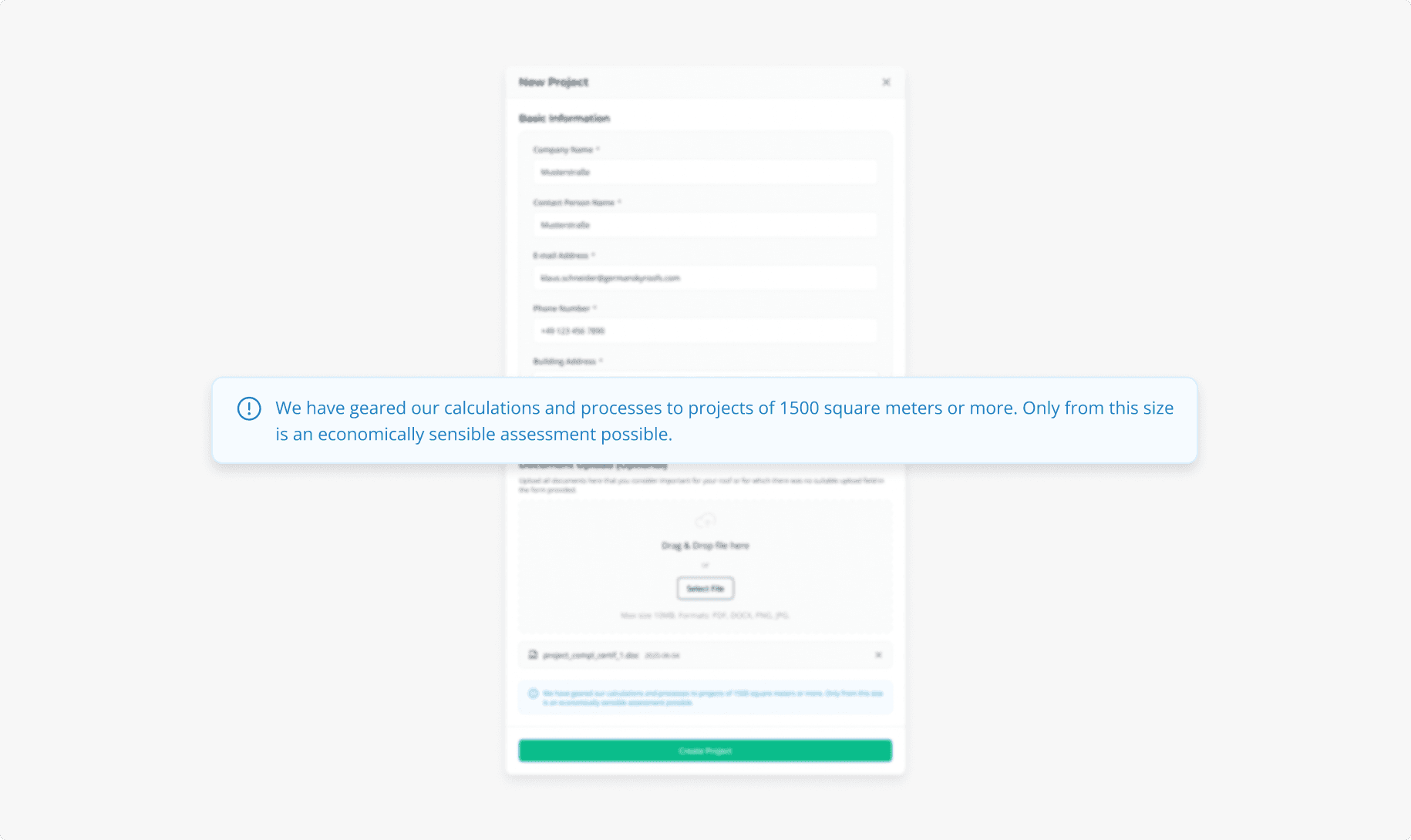
I added a note explaining that the service assesses rooftops of 1,500 square metres or more. This made the size requirement visible before owners created a project.
I added a note explaining that the service assesses rooftops of 1,500 square metres or more. This made the size requirement visible before owners created a project.
A notice explained the minimum rooftop size of 1,500 square metres before submission.
A notice explained the minimum rooftop size of 1,500 square metres before submission.
The work then continued with admins. From the companies screen, they could find rooftop owners, check their details, and open their projects
The work then continued with admins. From the companies screen, they could find rooftop owners, check their details, and open their projects
Admins could find rooftop owners, check their details, and open their projects.
Admins could find rooftop owners, check their details, and open their projects.

Admins could open a project, review the submitted information, and coordinate the remaining technical details before inviting installers.
Admins could open a project, review the submitted information, and coordinate the remaining technical details before inviting installers.
Admins reviewed submissions and coordinated the remaining technical details before inviting installers.
Admins reviewed submissions and coordinated the remaining technical details before inviting installers.

When an invitation arrived, installers could review the location, project size, roof details, and completion deadline. They could then approve or decline the invitation from the same list.
When an invitation arrived, installers could review the location, project size, roof details, and completion deadline. They could then approve or decline the invitation from the same list.
Installers reviewed project and roof details, then approved or declined invitations.
Installers reviewed project and roof details, then approved or declined invitations.

Project creation was part of a wider redesign covering rooftop owners, admins, and installers. These screens show how each role’s work connected across project management, coordination, and monitoring.
Project creation was part of a wider redesign covering rooftop owners, admins, and installers. These screens show how each role’s work connected across project management, coordination, and monitoring.
The wider redesign connected rooftop owners, admins, and installers across project management and monitoring.
The wider redesign connected rooftop owners, admins, and installers across project management and monitoring.

The multi-role flow let owners start with the basics info and then admins and installers handle the rest.
Validation
More owners finished the form. I’d check the work that followed.
More owners finished the form. I’d check the work that followed.
The shorter form needed to do more than look easier. After launch, the client’s before-and-after analytics showed fewer people leaving and more proposals becoming contracts.
The shorter form needed to do more than look easier. After launch, the client’s before-and-after analytics showed fewer people leaving and more proposals becoming contracts.
The client’s before-and-after analytics showed fewer people leaving and more proposals becoming contracts.
The client’s before-and-after analytics showed fewer people leaving and more proposals becoming contracts.
What the client measured
Form abandonment fell by 35%. Fewer owners left before completing the form.
Form abandonment fell by 35%. Fewer owners left before completing the form.
Proposal-to-contract conversion rate increased by 28%. More proposals reached a signed contract.
Proposal-to-contract conversion rate increased by 28%. More proposals reached a signed contract.
Form abandonment fell by 35%.
Form abandonment fell by 35%.
Proposal-to-contract conversion rate increased by 28%.
Proposal-to-contract conversion rate increased by 28%.

What the results told me
Lower abandonment supported asking owners for less upfront. The increase in signed contracts was encouraging, but it also depended on the work after submission.
Lower abandonment supported asking owners for less upfront. The increase in signed contracts was encouraging, but it also depended on the work after submission.
Neither figure showed whether the shorter form made that work easier for admins and installers.
Neither figure showed whether the shorter form made that work easier for admins and installers.
Lower abandonment supported asking owners for less information. Neither figure showed whether the work became easier for admins and installers.
Lower abandonment supported asking owners for less information. Neither figure showed whether the work became easier for admins and installers.

What would prove me wrong
Removing fields could shift the difficulty to the team. If admins repeatedly had to contact owners for the same missing information, I’d reconsider when to ask for it.
Removing fields could shift the difficulty to the team. If admins repeatedly had to contact owners for the same missing information, I’d reconsider when to ask for it.
The aim was to make projects easier to create without making them harder to continue.
The aim was to make projects easier to create without making them harder to continue.
If missing basic information repeatedly blocked the team’s work, I’d reconsider what the form required.
If missing basic information repeatedly blocked the team’s work, I’d reconsider what the form required.
How I’d check it
I’d follow submitted projects through admin review and installer invitations.
I’d follow submitted projects through admin review and installer invitations.
I’d record which details were missing, when owners needed to be contacted again, and whether missing information delayed the next step.
I’d record which details were missing, when owners needed to be contacted again, and whether missing information delayed the next step.
I’d follow projects through admin review and installer invitations, recording missing details, repeated requests, and delays.
I’d follow projects through admin review and installer invitations, recording missing details, repeated requests, and delays.

The results showed more owners getting through. They didn’t show how much work came after.
The first review exposed the problem. The second confirmed the new direction.
Reflection
I’d keep the simpler start. I’d review the team’s next steps sooner.
I’d keep the simpler start. I’d review the team’s next steps sooner.
What I'd defend
Owners shouldn’t need to complete a technical assessment just to create a project. I’d keep the basic form and optional uploads, with admins and installers handling the remaining details.
Owners shouldn’t need to complete a technical assessment just to create a project. I’d keep the basic form and optional uploads, with admins and installers handling the remaining details.
I’d keep the basic form and optional uploads, with admins and installers handling the technical details.
I’d keep the basic form and optional uploads, with admins and installers handling the technical details.

What I'd do differently
I’d review the minimum information with admins and installers earlier. For each field, I’d ask what they needed it for and when they needed it.
I’d review the minimum information with admins and installers earlier. For each field, I’d ask what they needed it for and when they needed it.
That would give me a stronger basis for deciding what belonged in project creation.
That would give me a stronger basis for deciding what belonged in project creation.
I’d review the required information with admins and installers earlier, asking what they needed and when.
I’d review the required information with admins and installers earlier, asking what they needed and when.

What I'd watch
A successful submission could feel like the work was finished. Owners still needed to understand that the team might contact them for more information.
A successful submission could feel like the work was finished. Owners still needed to understand that the team might contact them for more information.
I’d pay attention to whether the confirmation set that expectation clearly.
I’d pay attention to whether the confirmation set that expectation clearly.
I’d check whether the confirmation made it clear that the team might contact owners for more information.
I’d check whether the confirmation made it clear that the team might contact owners for more information.
Making the first step easier was only part of the job. Each role needed to know what came next.
Showcase
The new first five minutes
The new first five minutes


Contact
Have a role in mind?
imran.uxi@gmail.com
Copied
© 2026 Imran. All Rights Reserved.
Contact
Have a role in mind?
imran.uxi@gmail.com
Copied
© 2026 Imran. All Rights Reserved.
Contact
Have a role in mind?
imran.uxi@gmail.com
Copied
© 2026 Imran. All Rights Reserved.
Contact
Have a role in mind?
imran.uxi@gmail.com
Copied
© 2026 Imran. All Rights Reserved.
Contact
Have a role in mind?
imran.uxi@gmail.com
Copied
© 2026 Imran. All Rights Reserved.